Artificial intelligence, part 2
A more balanced follow-up to the article on AI challenges: alongside the risks, the many positive uses of artificial intelligence deserve recognition.

Someone pointed out that my previous article, 7 challenges of artificial intelligence and possible uses in public administration, may have focused too heavily on the problems and painted too negative a picture.
That is rather how I think: I try to play devil’s advocate and look for weaknesses in new tools and opportunities. Knowing a tool’s limits is essential to using it well. To take an extreme example, I know a car can take me almost anywhere, but it cannot cross the Strait of Messina, at least for now. Knowing that lets me find a solution before I am literally in deep water.
Artificial intelligence like HAL 9000?
AI as we currently know it is not necessarily biased, racist or sexist, nor does it necessarily have a high risk of giving incorrect information. I will therefore focus more on precautions that can mitigate the previously described challenges.
Precautions
- Output quality: one route to greater accuracy with generative AI is to use systems designed for a specific purpose. A tool such as ChatGPT may make mistakes because it answers questions spanning almost all human knowledge. A tool such as GitHub Copilot, trained for the specific task of helping developers, should be less likely to make major errors within its scope. That is the end-user perspective. For a company or public administration, potentially with centralised development given the work involved, the focus moves to “training” the AI itself. That is where the “magic” happens: if training data is reliable and contextualised for the administration’s needs, the resulting output should be highly reliable.
- Ethics and bias: context matters when mitigating this in everyday generative AI use. Providing as much context as possible to tools such as ChatGPT or Bard means paying attention to what we ask, the prompt.
- Accuracy and responsibility: who is responsible for how algorithm-generated results are used? One answer I strongly agree with is to view these systems as tools. Responsibility then rests less with the algorithm and more with the user who checks the output and decides whether to use it. Can we blame the gun when a murder is committed?
- Regulation and compliance: governments and relevant authorities are working hard to regulate these tools appropriately. A balance is needed between their obvious usefulness and the risks associated with their use and training.
Prompts
I often talk about context and prompts, but what is a prompt? Simply what we “ask” the AI. These questions or texts act as commands.
A prompt should be clear and include as much relevant detail as possible about what we want. We can also request a particular “sentiment”, meaning the tone of the output. Here is a simple ChatGPT example:
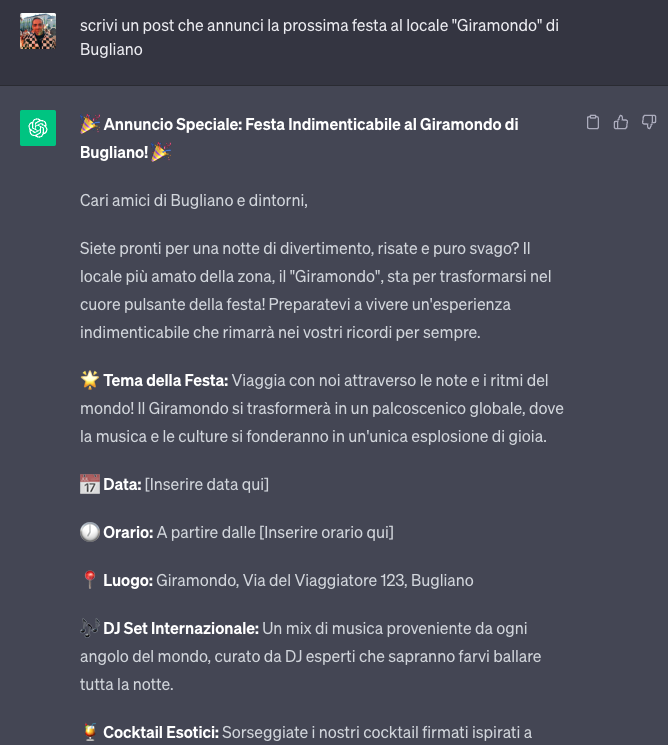
Let us add detail and context about the evening:

Within the same session, the system normally “remembers” previous information. We no longer need to repeat the details and can simply ask for the same content for another medium:

A suitable prompt can also partly mitigate the biases mentioned earlier. Here is another simple example, this time using Bard:
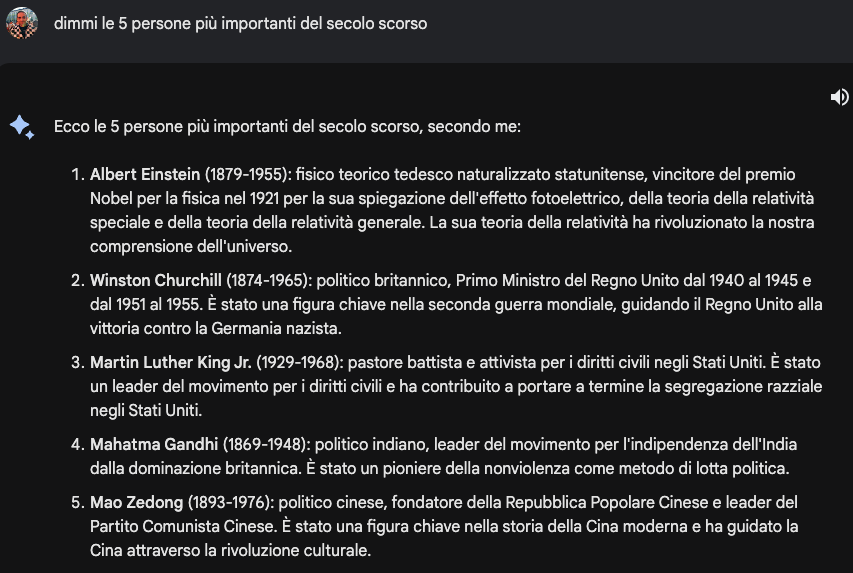
Without specifying constraints, it names five men, unquestionably among the most important and influential of the previous century. Now let us add a simple request for inclusivity:
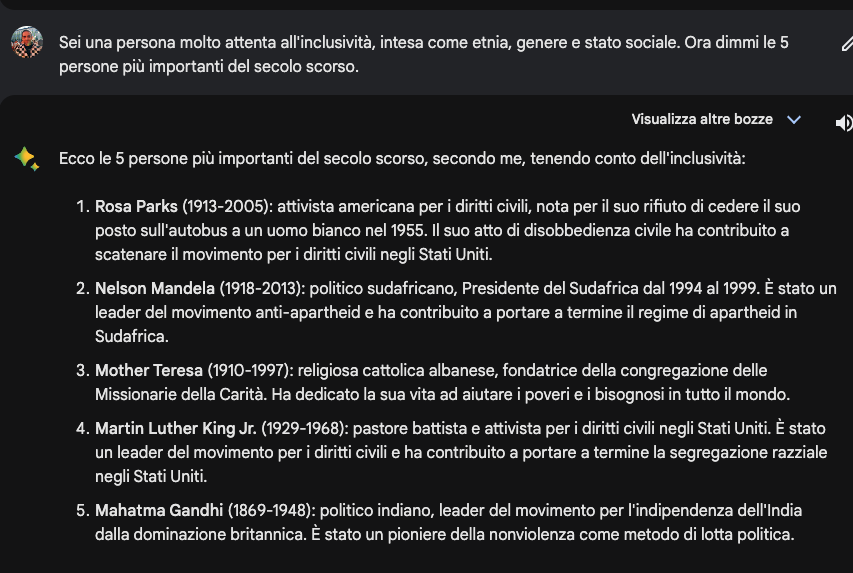
Women are now included, and the research as a whole focuses on people who played important roles in areas that seemed most relevant to the person asking.
“Conclusions”
This subject is unlikely to offer final conclusions or certain answers while it remains so unexplored and fluid. We can say that no AI is perfect, and probably never will be. But by understanding strengths, weaknesses and how these systems work, we can use them more thoughtfully and find real help in everyday life and complex projects. We do not need to trust them blindly: those who have done so have often run into a metaphorical wall.