DNS: the joy and pain of the internet
After AWS, Fastweb and Vodafone outages, an often invisible component takes centre stage: what DNS is, how it works and why its failure can stop half the internet.
The events
Today is 22 October 2025. This week we have seen two major outages: one affected internet services globally following a malfunction at AWS (Amazon Web Services); the other mainly affected two Italian telecoms operators, Fastweb and Vodafone.
The common denominator appears to be a malfunction in what is usually considered the least troublesome piece of infrastructure: DNS.
At roughly 9 a.m. Italian time on Monday 20 October, DNS records pointing to DynamoDB databases and other AWS services, including Lambda, began experiencing problems in some availability zones of us-east-1. Explaining AWS architecture in detail would require another article; broadly speaking, perhaps two or three data centres out of hundreds worldwide were affected. This caused internal AWS services and external services using that region to stop working or become severely degraded. Among them were Slack, Asana and several game servers. AWS’s internal services alone saw more than a hundred components degraded or unavailable.
While AWS teams were still clearing the last request backlogs, another problem emerged in Italy. This morning Fastweb and Vodafone experienced major issues, making almost the whole internet inaccessible mainly to their customers, although some sites, including several social networks, continued working. According to Fastweb’s statement, DNS problems were again responsible.
Some background
Let us step back: what is DNS, and why does it matter so much?
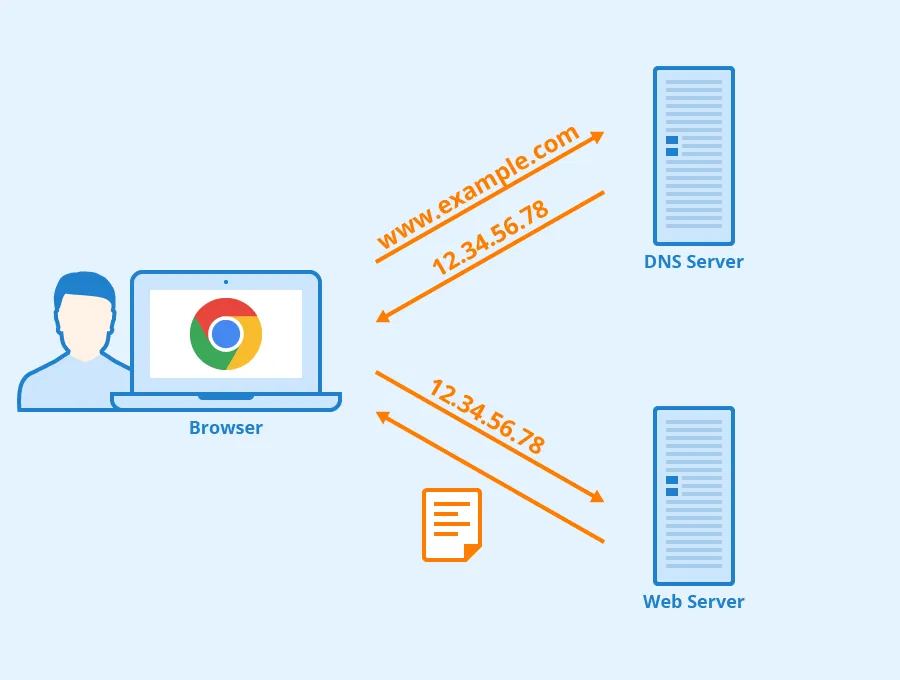
DNS stands for Domain Name System. It translates a name into an IP address. When you type https://www.martoranamarco.it into a browser, your computer first translates that rather odd name, from a machine’s perspective, into something more useful: an IP address, in this example 54.78.227.231, or ultimately a sequence of ones and zeroes a computer can understand. It is easy to see why this matters. Remembering “martoranamarco.it” is one thing; remembering “00110110.01001110.11100011.11100111” is another.
What exactly is an IP address? Having already simplified DNS considerably, I will simplify this even more: think of it as a street address that tells the computer where to request the content it needs.
A weak point that routine makes us underestimate
Dependence and centralisation
Leaving local and remote caches aside, essentially all our traffic depends on a single service, usually run by our internet provider. We can use Google’s DNS servers (8.8.8.8 and 8.8.4.4), OpenDNS (208.67.222.222 and 208.67.220.220) or others, but the principle is the same: when using internet services, we pass through one of these in 99% of cases.
Basic DNS configuration is not particularly complex. You can picture a table mapping names to IP addresses. That simplicity leads people to underestimate its importance, and many web service architectures provide no redundancy for it. When it fails, the entire service dies immediately.
Security and manipulation
The nature of this protocol also creates a potential security weakness: a man-in-the-middle (MITM) attack. Someone intercepts your request to translate a domain into an IP address and supplies a malicious address instead.
DNSSEC, Domain Name System Security Extensions, can prevent these and other attacks against DNS.
What these incidents teach us
The AWS problem shows that putting services “in the cloud” does not make them resilient by default. I have made this mistake myself: underestimating the possibility of trouble at a giant provider such as AWS, Google or Azure, and therefore failing to apply good resilience and redundancy practices.
When all traffic passes through one service with no redundancy or failover, a backup system ready to take over when the primary fails, we call it a single point of failure. Every systems administrator or DevOps engineer must prevent one from existing in an architecture. Years ago, doing this with physical systems was extremely expensive. Today, distributing services across data centres to reduce risk is relatively straightforward and not too costly. Doing the same for DNS remains one of the hardest tasks despite its apparent simplicity.
The AWS and Fastweb incidents show just how interconnected the network is. To adapt the butterfly-effect saying, one faulty DNS system in a US data centre can bring the accounts department of a business in inland Sardinia to a complete halt.
Conclusion
The internet as we know it depends on translating names into numbers and on connections between systems across the world. A small addressing error in the internet’s hidden heart can disrupt everything.
When the internet slows down, we remember that the cloud is a geography of servers, cables and human decisions that can suddenly become fragile.