Ivrea Carnival 2026: victories, the square and a reflection on judging
Ivrea Carnival 2026 brings victories to celebrate and questions about judging: what we can learn beyond the results in the squares.
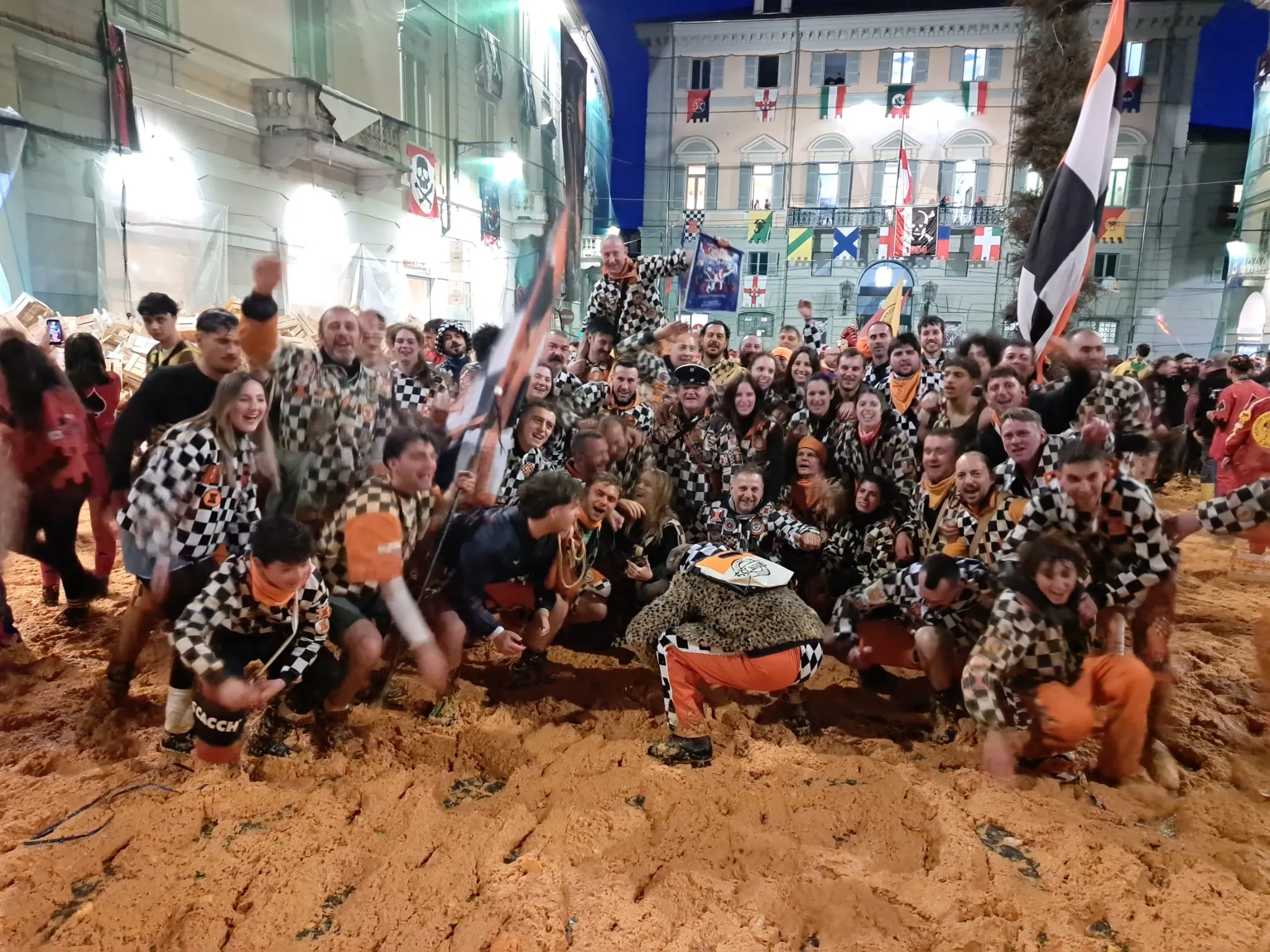
Some victories deserve celebration; others deserve analysis. Let me start with the first. Congratulations to the Diavoli, winners of Carnival 2026, and to the Arduini, who won the palio. Two important achievements in an exceptionally strong edition, deserving full respect.
Carnival 2026 from inside the square
For me, 2026 was unusual: for various reasons I only made it to our headquarters on Monday, so I experienced it entirely as an orange thrower. From inside the square, the perspective is very concrete. No narratives, just exertion. No impressions, just intensity.
The Scacchi were excellent throughout: presentation, parade, organisation and throwing. Whatever the clichés and often debatable scores, we threw hard in the square. The exhausted faces of the throwers on the carts leaving Piazza Ottinetti said more than any comment. In 2026 that square was full and fierce again, partly thanks to the Arduini’s strong recovery. The standard across the teams was extremely high.
The issue is the method, rather than who wins
Precisely because the teams are so strong, a question is unavoidable. What is the point of rankings that seem settled weeks beforehand? Until we find the most objective possible way to assess teams, at least six will have solid reasons to feel they deserved first place every year.
The only truly objective ranking is the palio. Yet in 2026 even that was not enough to change a result many felt was already decided, except to almost force the Scacchi onto the podium. That takes nothing away from the Diavoli, but raises a serious question about the judging system.
Every team has a case for first place
Would anyone really blame the Tuchini, Mercenari, Morte, Picche, Scacchi or Pantere for privately believing they deserved to win in 2026? Given this year’s standard, that feeling would be understandable.
When standards are this high, discretion matters more. That is exactly when greater clarity is needed.
Technology, objective criteria and transparency
The technology to introduce more objective criteria exists. We can study measurable parameters, shared tools and more transparent systems. Clear indicators for fighting spirit, actual presence in the square and throwing intensity, with explicit criteria for presentation and organisation.
This is a concrete offer rather than a provocation: I am available to work with the organisers on solutions that make team assessments clearer and less open to interpretation.
In the meantime, we can start with simple foundations: explicit, shared criteria and complete public scores as early as Tuesday evening. Transparency does not eliminate disagreements, but it makes them more mature.
A credible system and respect for every team
In the past, I have looked at the cart teams’ scores and, honestly, in years when the Credendari numbered fewer than a hundred, seeing them score above the Scacchi made me smile. I say that with respect for the Credendari, whose steady growth I greatly appreciate. In forty years of Carnival, theirs is the only uniform besides my own that I have worn for a day of throwing.
That is precisely why I believe that, with the standard we saw in 2026, the system’s credibility must be beyond question.
Strengthening Carnival 2026 and future editions
The aim is to strengthen Carnival, rather than fuel arguments. When the rules are clear and measurable, the deserving team wins and everyone recognises it.
Arvedze a giòbia ’n bot. Until we meet again on Carnival Thursday. Because a lively square is the most authentic sign that Carnival still truly matters.