Olympics or Sanremo?
Two national rituals, engagement and manufactured controversies: what the way we follow the Olympics and Sanremo says about us.

Introduction
We know very well that the Sanremo music festival is a festival of controversy. The circus around it does everything possible to keep attention and engagement high. There are countless examples, on topics of varying importance, from Rula Jebreal’s monologue to John Travolta doing the duck dance with conspicuously visible shoes.
What we perhaps were not used to was the Olympics getting the Sanremo treatment. Debate becomes political and polarised immediately. Let us look at the three most striking examples from this edition.
The opening ceremony
The opening ceremony included a performance that could have recalled the Last Supper. That prompted the usual accusations of attacking Christianity and showing disrespect through drag queens and other supposedly inappropriate figures.
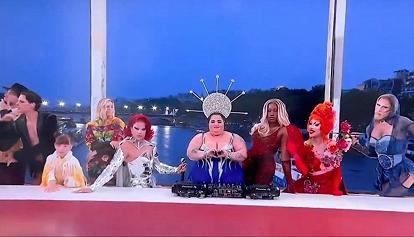
The ceremony’s creator quickly explained that Dionysus, rather than the Last Supper, was the inspiration, but the controversy was already underway.
There is little to say: a sterile political argument of limited interest, with the usual politicians using outrage to speak to their electorate.
The culture of success
After missing a medal in the 100-metre breaststroke by one hundredth of a second, Benedetta Pilato was visibly happy in her immediate interview, calling it the best day of her career on RAI.
Elisabetta Caporale immediately asked, “Really?” Later in the studio, Di Francisca went further with disrespectful remarks such as “Is she serious or pretending?” and “Interview her again, because I didn’t understand any of that.”
Elisa Di Francisca’s comments on YouTube
Everyone weighed in, some supporting Pilato, others understanding Di Francisca’s view. Beyond her communication, which I think Di Francisca got completely wrong, much has been said about the “culture of success” being toxic. I do not agree, just as I do not think we should remove the word failure from sport, as Giannis Antetokounmpo suggested about a year ago.
A precise distinction is needed: success and failure are deeply subjective. Fourth place was clearly a success for Pilato. Had she not even made it through the heats, I imagine she would have spoken differently, and it would have been a failure.
Competitive sport has rankings, times and results. You compete to achieve the best result possible. At this level, athletes know where they stand against rivals, so they need a target before competing. Exceed it and you succeed; perform around it and that is normal; fall far below it and you fail.
What I would condemn is blaming people for failure. Failure is part of everyone’s life, including highly successful people and athletes. No successful person will claim never to have failed, but all will say they learned a great deal from it. That is how we should experience it.
Intersex, trans and testosterone
Now the elephant in the room: Imane Khelif. The 25-year-old Algerian boxer, with 47 fights, made headlines in 2023 after failing a “gender test” before the world championship final, reportedly for excessive testosterone. Beyond that there is uncertainty. The apparently better-founded reports describe a woman assigned female at birth whose condition causes higher testosterone production. Other rumours claimed a DNA test showed XY chromosomes and therefore described her as transgender, something prohibited in her country.
Then came the fight against Italy’s Angela Carini, who had 107 bouts behind her. She withdrew in under a minute, saying she had never been hit so hard. The controversy exploded. Politicians with particular ideological positions, from Salvini and Meloni to Erdogan and Trump, seized the opportunity, muddying the waters and turning an important issue into crude propaganda. Khelif’s nearly fifty fights without an opponent withdrawing, and only five knockouts, suggest two possibilities:
- Her strength has increased enormously over the past year; perhaps the next fights will tell us.
- Carini was partly overwhelmed by the situation. Without entertaining conspiracy theories, the visibility may undoubtedly bring her more income than an amateur career in women’s boxing.
There is no simple resolution. Political interests, sporting and ethical questions, and economic interests are intertwined. I would first distinguish athletes who, as Khelif appears to have been, were born and raised female from transgender athletes. In the first case, once external causes of testosterone production are ruled out, I see no fair reason to exclude them. In the second, decisions should rest with science, prioritising fair competition and preventing deliberate manipulation to enter women’s sport. That may sound extreme, but we have heard terrible stories of sports programmes dosing athletes with substances to win medals. It would not surprise me to see other boundaries crossed.
A brief aside: as far as reported here, no transgender athlete has yet won an Olympic medal, despite being allowed to compete under certain conditions. I therefore wonder whether the existing rules may already be adequate. What matters is consistency across federations, avoiding controversies where an athlete is excluded from a world championship but admitted to the following year’s Olympics.
The Seine
Amid all this, the issue that deserved more controversy in my view was the triathlon swim in the Seine. It was so polluted that cancelling the swim was considered. It went ahead, but with problems. Here are some remarks from participants who had taken probiotics and similar precautions before entering the water:
We noticed a strange smell while swimming.
I gave everything and have no regrets. I would do it again, even though I vomited ten times. The Seine was not clean, but I would do it again.
I swallowed a lot of water, so tomorrow we will know whether I get sick. Obviously it does not taste like Coca-Cola or Sprite. Swimming under the bridge, I noticed the smell and told myself not to think about it. The Seine has been dirty for a hundred years, so you cannot say athlete safety is a priority.
I took probiotics and drank my Yakult. I could not do more. I intended not to swallow water, but swallowed too much.