Parents’ mental load: the work nobody sees
Parenting is about remembering everything as well as doing it. Mental load is invisible work that never switches off. Even sharing it creates more coordination.
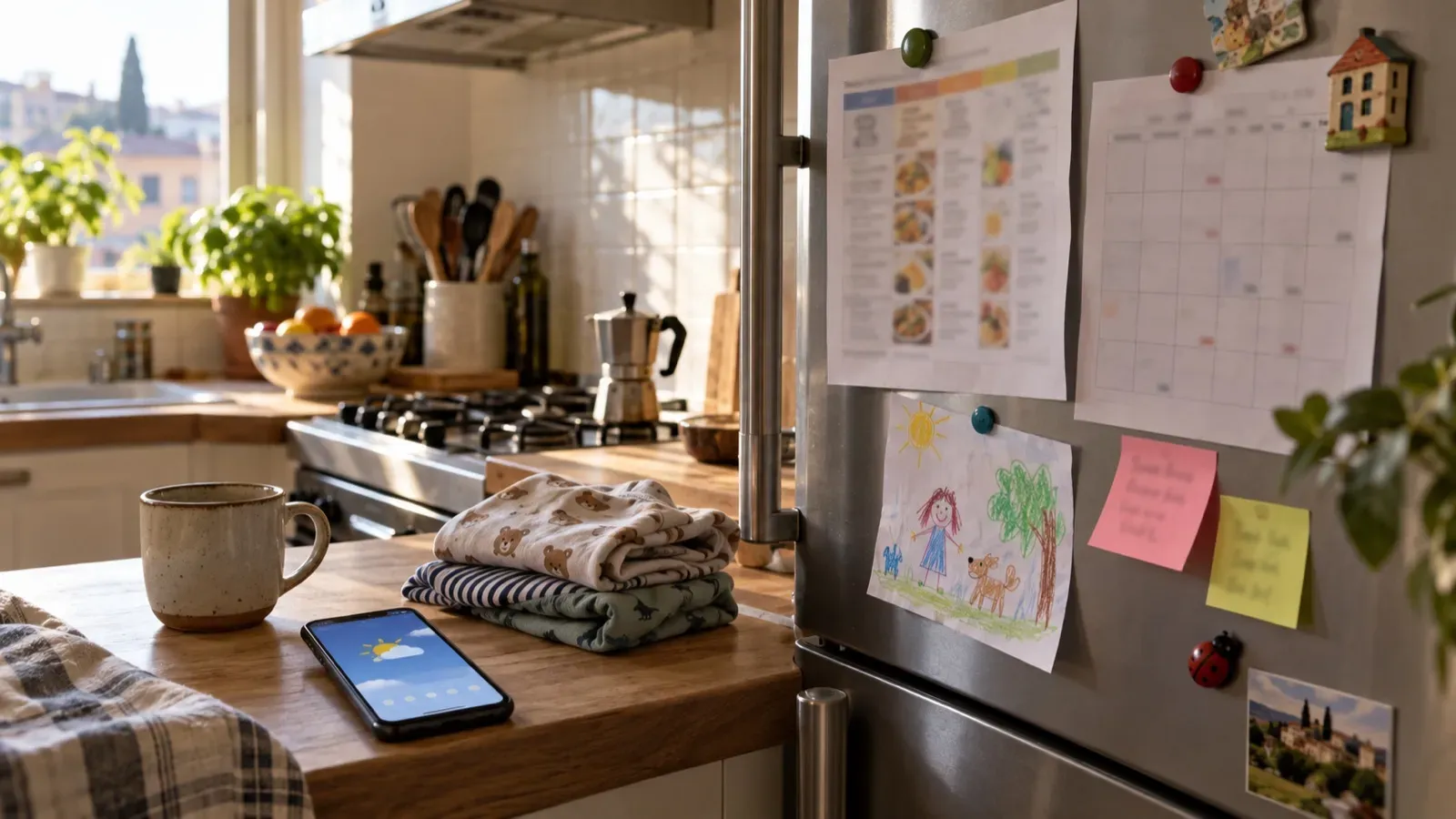
There is a part of parenting we rarely talk about because it is invisible. It is not taking children to school, making dinner, doing the washing or driving them to sport. Those are things you do, things people see. It is something else: keeping everything in your head.
Remembering that Tuesday is a longer school day and they need a packed lunch. That their good shoes are too small and need replacing before the cold weather. That a vaccination was due and nobody sent a reminder. That the washing machine’s warranty expires in November. That tomorrow the older child has a school trip and the younger one does not, so their mornings will be different. That the medicine is running out. That a form needs signing by Friday.
None of these things is heavy on its own. What makes them heavy is holding all of them in your head, together, simultaneously and continuously.
It is not doing. It is remembering to do
That is mental load: the background process that never shuts down. While you work, while you sleep, while you thought you had relaxed for a second, part of your brain keeps checking the list. Not the written list; that one is easy. The list you keep in your head because you cannot trust yourself to forget it.
It is real work, even if nobody calls it that. It requires attention, planning, memory and the ability to anticipate. It just produces nothing visible. Nobody thanks you for remembering a deadline in time. You only notice when one gets missed.
Sharing it does not make it disappear
In our family, we share the load. I have two children, aged two and five, and my partner and I try to carry it together. That is already fortunate: in many couples it is not shared at all, falling entirely on one person, more often the mother. Managing to share it is an achievement.
But dividing mental load does not eliminate it. It turns it into coordination. If two of us handle it, I need to know what she knows, and vice versa. I need to keep her shifts in mind to work out whether I am picking up the children today. It sounds trivial, but the whole day revolves around it. I need to remember whether the older child has an afternoon activity. I need to know what is on the school lunch menu, because it changes what I plan for dinner.
Individually, tiny things. Together, every day, synchronised between two people, they are exactly the same invisible work as before, with the added burden of keeping both of us aligned.
The morning I understood it
For a long time, our mornings started like this: check the weather forecast to decide how to dress the children, then find the school lunch sheet and work out which week of the menu rotation we were on, to know whether they would eat lunch and what they would have.
Two small actions, repeated every single day, before even having coffee. The problem was not the effort of doing them. It was having to think about them every time, from memory, with a sheet stuck to the fridge. One ordinary morning I had a simple thought: this stuff should not have to live in our heads.
Something I learned from work
My job is managing people and systems. Something obvious at work can take us years to understand at home: a group should not keep important information in a single person’s head.
A functioning team does not rely on somebody’s memory. It puts deadlines where everyone can see them, automates reminders and shares what needs remembering. Not because people are forgetful, but because keeping everything in your head is fragile and exhausting, and sooner or later something slips.
A family is not a work team, and treating it like a project board would be a mistake. But on this one point the principle holds: remembering can move out of one person’s head and become shared. Not to optimise the family, but to take weight off whoever carries that load, alone or simply trying to share it.
Where I am going with this
This is the problem I care most about right now, and the one I am working on with Taita: moving parents’ mental load out of their heads and into a system that remembers for them. Deadlines, appointments, vaccinations, school lunches, expiring warranties, communicated to the right person at the right time.
But I will talk about Taita another time. Today I wanted one thing: to name a job that so many parents do every day without anyone seeing it. If you read this and thought “I do that, and nobody notices”, that was exactly the point.
Note — I wrote this article with help from AI to structure the text and refine its wording. The experience, perspective and opinions are mine. It seemed right to say so.